
If you are heading into a raise, you probably have 3 sets of numbers. A process model from your engineers. A TEA behind the financial case. An LCA behind the carbon claims. Each of them can be perfectly sound. (Often, they still disagree.)
That disagreement is what an investor’s technical adviser looks for first. Every engineering, economic and environmental figure in your GreenTech business case should come from a single validated mass and energy balance, and every cost should be expressed per net tonne of CO2. Otherwise you are handing diligence two answers and asking them to pick one.
On a decarbonisation feasibility study I worked on ten years ago, one partner built the TEA, and another worked on the LCA. Despite regular catch-ups, we later found we were using different process boundaries. The LCA counted the emissions from generating the electricity used to make hydrogen. The TEA did not.
We found this when the results didn’t reconcile. Aligning the 2 models moved the headline KPIs by 10–20%. Nobody had done anything unusual, as TEA and LCA need different skills, and small teams often commission them at different times. I’ve learned this the hard way, but this experience helped me become better at what I do.
Here is what you can do to avoid this mistake.
Start from a single energy and mass balance, tested across the operating envelope
Your mass and energy balance is where performance, energy use and emissions are physically linked. If your TEA takes its electricity demand from one version of it and your LCA from another, your case contradicts itself before anyone has asked a question.
The balance also needs evidence. At pilot stage, that means a design of experiments that maps the operating envelope, not just one good run. What you test depends on the technology. For example, for a solid-sorbent, low-temperature direct air capture process, I would want to see different adsorption and desorption times, different regeneration temperatures, and the effect of moisture on both the capture rate and the regeneration energy, because your cost and your carbon figure both depend on them.
Normalise every cost on a net tonne
Carbon Engineering’s published design shows why the difference between gross and net CO2 removal rate matters. In the paper Keith and colleagues published in 2018, the plant captures 0.98 MtCO2/yr from the air. However, it delivers a 1.46 MtCO2/yr CO2 stream for purification and storage. This is because another 0.48 MtCO2/yr comes from burning natural gas on site to run it. The company’s own life-cycle estimate then puts net permanent storage at roughly 0.9 tCO2 for each tonne of CO2 captured from the air.
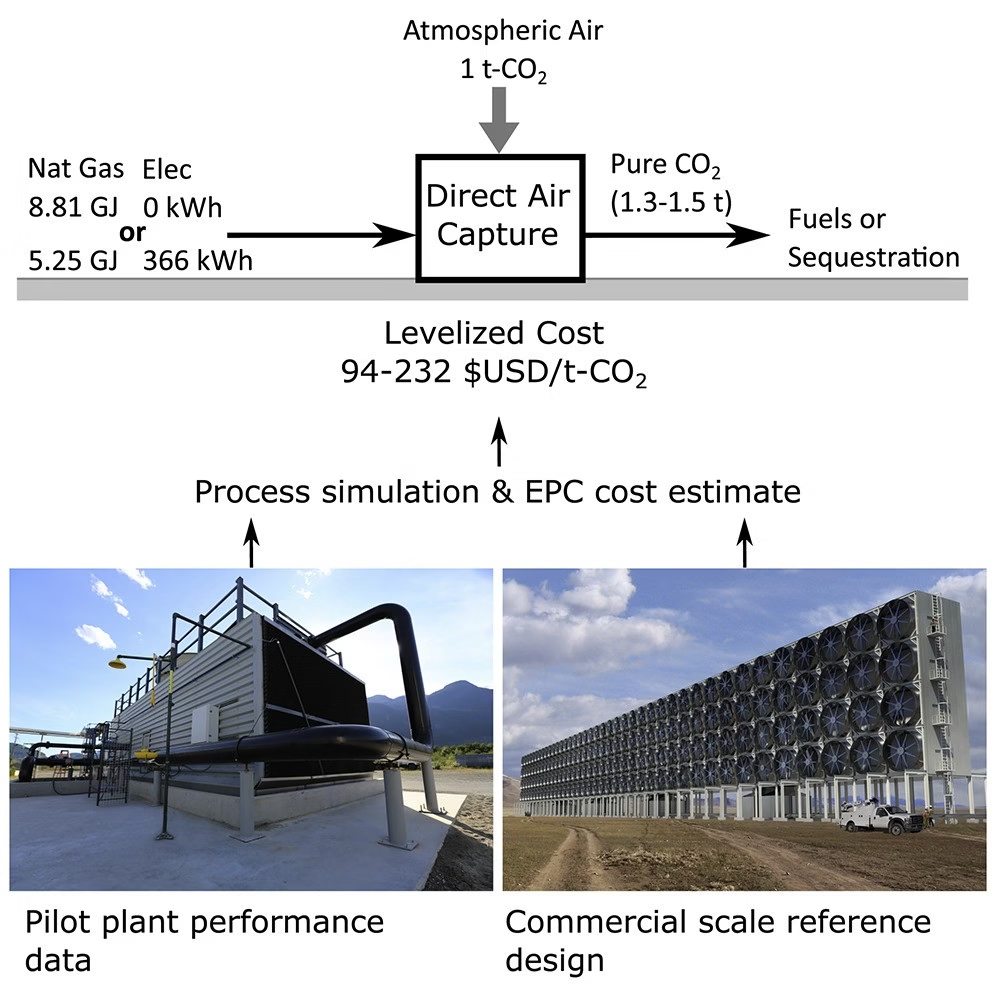
So the question investors and offtakers will often ask of a GreenTech business case is which is the “right tonne”: 1.46, 0.98 or about 0.9 MtCO2/yr? If you divide the same annual cost by the delivered stream rather than the net figure, your cost per tonne will be roughly 40% lower. The paper is clear that its costs are per tonne captured from the air. Pitch decks aren’t always that careful, and the buyer pays for the net tonne.
Vary the inputs that move both TEA/LCA models
The inputs you are most likely to hold fixed are the ones that move your cost and your carbon result at the same time.
Project lifetime is the obvious one. It is usually a single number, but in the TEA it sets how long you have to recover the capital, and in the LCA it sets how many tonnes the construction emissions are spread across. If it is shorter, both your cost per tonne and your emissions per tonne go up.
Cheap renewable electricity is the other. It usually goes into the model as generation cost, and I’m not convinced that still holds. The IEA expects data centre electricity consumption to more than double, from 415 TWh in 2024 to around 945 TWh by 2030, with renewables meeting around half of that growth. Renewable output is also variable. If your plant needs a steady power supply, it needs energy storage or firm backup generators. This cost rarely makes it into the TEA model. When I work with start-ups, I always recommend that your TEA should carry the cost of energy delivered to the plant, and your LCA the carbon intensity of that same supply.
What to check in your GreenTech business case before the data room opens
Put your TEA and your LCA side by side and check 3 things: the same electricity demand, the same process boundary, the same tonne. When I ran the techno-economic assessment for PolyCapture, energy use, emissions, and costs all came from a single process model I built and validated, through to CO2 compression, transport, and storage, so the cost and carbon figures always described the same plant.
If your models differ on any of those points, find out which one is right before an investor asks. That is hard to do from the inside. The person who drew the boundary is the least likely to see what sits outside it.
How I help you
I help GreenTech companies, including carbon removal and carbon capture companies, determine whether their technology and business case are ready for the next funding, offtake, diligence or deployment decision.
I independently challenge the engineering, economic and environmental assumptions behind the GreenTech business case.
The aim is to understand what the evidence supports, which assumptions matter most, where the main evidence gaps are, and what needs to be resolved before the next decision.
I do this through three services:
- Commercialisation Readiness Review: An independent review of your technology, assumptions, risks and readiness for the next commercial decision.
- Scale-Up & Techno-Economic Assessment: I assess whether expected performance, CAPEX, OPEX, utilisation and scale-up assumptions support a credible commercial case.
- LCA & Carbon Integrity Assessment: I assess lifecycle emissions, net carbon benefit, system boundaries, uncertainty and the environmental claims behind your technology.
You receive validated, evidence-based numbers; an assessment of the main data and evidence gaps; and a practical view of what needs to happen next.
No black-box models. No optimistic assumptions left unchallenged. No TEA and LCA sitting in isolation from the engineering.
Send me a message if you need to know what your evidence really supports before you commit capital, publish claims, or sign contracts.
Who is Dawid?
Professor Dawid Hanak is a global expert in techno-economic assessment, life-cycle assessment and the commercialisation of GreenTech, carbon removal and carbon capture technologies. A 14+ year practitioner, he has led more than 50 research and commercial projects, secured over £5 million in external funding, and advises the UK Government on carbon management technologies.
If you enjoyed this content, please follow, reshare, and subscribe to see more.