Reviewers expect an early TEA to be wrong. What they mark down is a method they cannot trust and a metric that does not describe the investment.
When I review a techno-economic assessment for a journal such as Applied Energy, I ask one question: is the method right?
But when I evaluate a high TRL scale-up and commercialisation proposal, i.e. for Horizon Europe or for Cyprus’s Research and Innovation Foundation, I ask different questions:
- does this number hold for the proposed plant?
- can it lead to market competitiveness?
- will the proposed business model achieve market readiness as a result of this programme?
Most TEAs written by research teams are built to pass the first test. Founders who came out of a lab carry that habit into their first raise or grant application. And it makes sense, because it is the standard they were trained to. But it is not the standard the technical reviewer applies.
I’ll say the uncomfortable part plainly: at startup stage, your TEA is likely to be wrong.
Join the TEA cohort waiting list.
The first small-group cohort is planned for early 2027. Dates and fee are not fixed yet. People on the waiting list hear first and get first refusal on places: drhanak.com/training-sign-up
The design is still moving, the performance data is thin, and nobody has quoted your reactor yet.
Every experienced reviewer knows this, so an inaccurate number is rarely what sinks the case.
What will reduce your overall score and likelihood of funding is a workflow the reviewer cannot trust, and economic metrics that do not represent the investment you are asking them to back.
Below are the 4 places I see academically sound TEAs lose a reviewer, in the order I usually meet them, and what each one costs you. I will also work through them with founders in the small-group TEA cohort planned for early 2027.
Your capital cost stops at the equipment
Many research TEAs report the cost of the equipment: the reactors, compressors and heat exchangers, priced from the literature and scaled to size. That is the number papers compare, so it is the number research teams learn to produce. A reviewer reads it as part of a plant, not as a plant.
I saw exactly this in a commercialisation project I evaluated for Horizon Europe. The TEA costed the bare equipment and stopped there. There was no step up to the full project cost, no contingency and no escalation. The business case was marked as a significant weakness, and that cost the team the funding. The technology may well have been good. The capital cost simply did not describe a project anyone could build.
The missing step is one that large engineering studies take as standard. In a 2019 study I co-authored, we built the capital cost the way the US National Energy Technology Laboratory (NETL) baseline studies do, considering labour, engineering and project costs on top of the equipment, then land and owner’s costs, then a multiplier to reach the total as-spent cost. With the factors we took from the NETL baseline, every 1 € of bare equipment became about 2.1 € before land and owner’s costs were added.
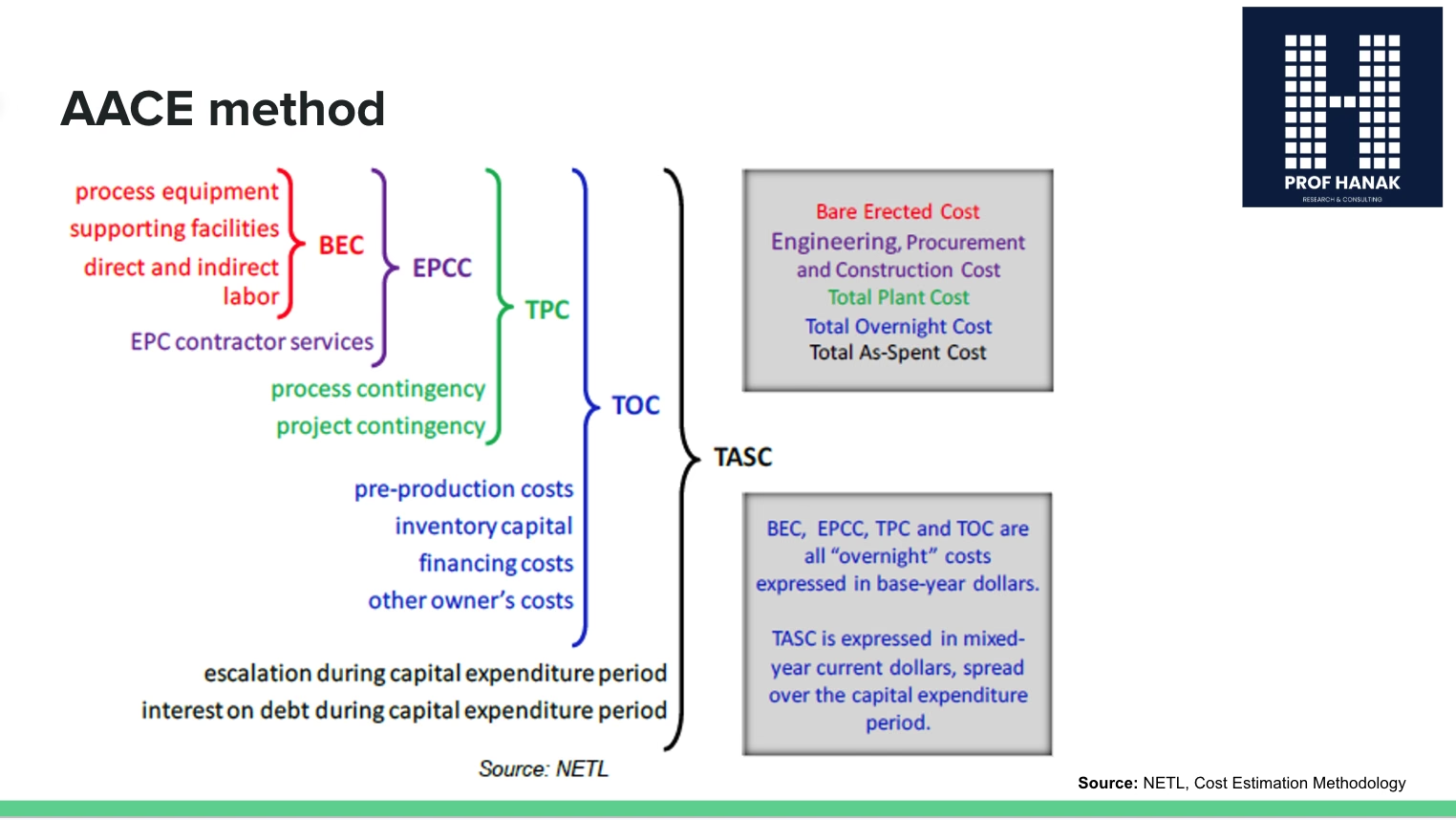
I learnt this on my own work. In 2017 I published a TEA of a calcium looping combustion power plant with a specific capital cost of 1,837 €/kW. When we rebuilt that cost on the total as-spent basis in 2019, using the same NETL reference data, it came out 40% higher, at 2,574 €/kW. Same plant, same cost data. The difference came mainly from the method.
When you get this right, the reviewer recognises your CAPEX as a project cost. They don’t rebuild it, the discussion moves to your technology instead of your spreadsheet, and the number in your deck survives the first read. In the cohort, you build this step on your own model, so you can explain every factor.
If your CAPEX just considers an equipment list, send me a message and we can look at what it stands for before a reviewer does.
Your design basis is a reference plant, not yours
Research TEAs usually start from a reference plant in the literature, at a scale and in a setting chosen because the cost data exist. For comparing concepts on equal terms, that is the right choice.
I did it too: our 2019 study was built around a NETL reference case.
A reviewer funding your first unit wants something else. They want your feed, your scale, your utilities, your operating hours and your site. If the TEA describes a plant from a paper, they cannot tell whether the numbers apply to the plant you are raising money to build.
What good looks like is a design basis written down near the front of the TEA. This should at least include:
- capacity
- operating hours
- feed requirements
- product rates
- utility and offtake prices
- project location
Each one should be marked as fixed or assumed.
Every cost and every performance figure traces back to it. I wrote in Why your TEA may be built for the wrong funding round about how far location alone can move a cost.
Once you fix the design basis, the TEA starts working for your engineering decisions as well as your raise. The reviewer can check it against the plant you will build, and you can see which design choice is worth testing next. The cohort has you write this design basis for your own plant before any cost is built on it.
Your performance figures are targets, not measurements
Research TEAs often model the process at the performance it should reach. Such conceptual designs give us the design capture rate, the sorbent life we expect, the overall energy or material efficiency.
And this is fine for a research paper, because the question it answers is what the concept could achieve.
For commercialisation, however, the reviewer is after evidence and usually asks what your team has already demonstrated.
Remember, at seed stage, nobody expects every input to be measured.
What they do expect is to see which numbers were measured, which were modelled and which are targets, where each one came from, and how far the measured value sits from the one in the model.
This is the third thing I look for when I evaluate a proposal, after the CAPEX and the design basis.
If I cannot tell which numbers were measured, I have to assume none were, and then every result in the model carries the same doubt.
But it doesn’t mean you need to know everything.
Once you identify and label the gap in your TEA, it becomes a milestone to be tested rather than uncertainty.
The test that would close this gap is something that your next grant or an investor can fund.
But when you leave it unlabelled, it will become a reason to discount the whole case. Cohort members tag each assumption in their own model by its source, so the gaps show early.
Your headline metric leaves out the money
The levelised cost of electricity (LCOE), or of your product, is the standard metric in academic TEAs. And it is a good one for comparing technologies.
But it does not account for tax, interest or depreciation, and it says nothing about how the project is financed.
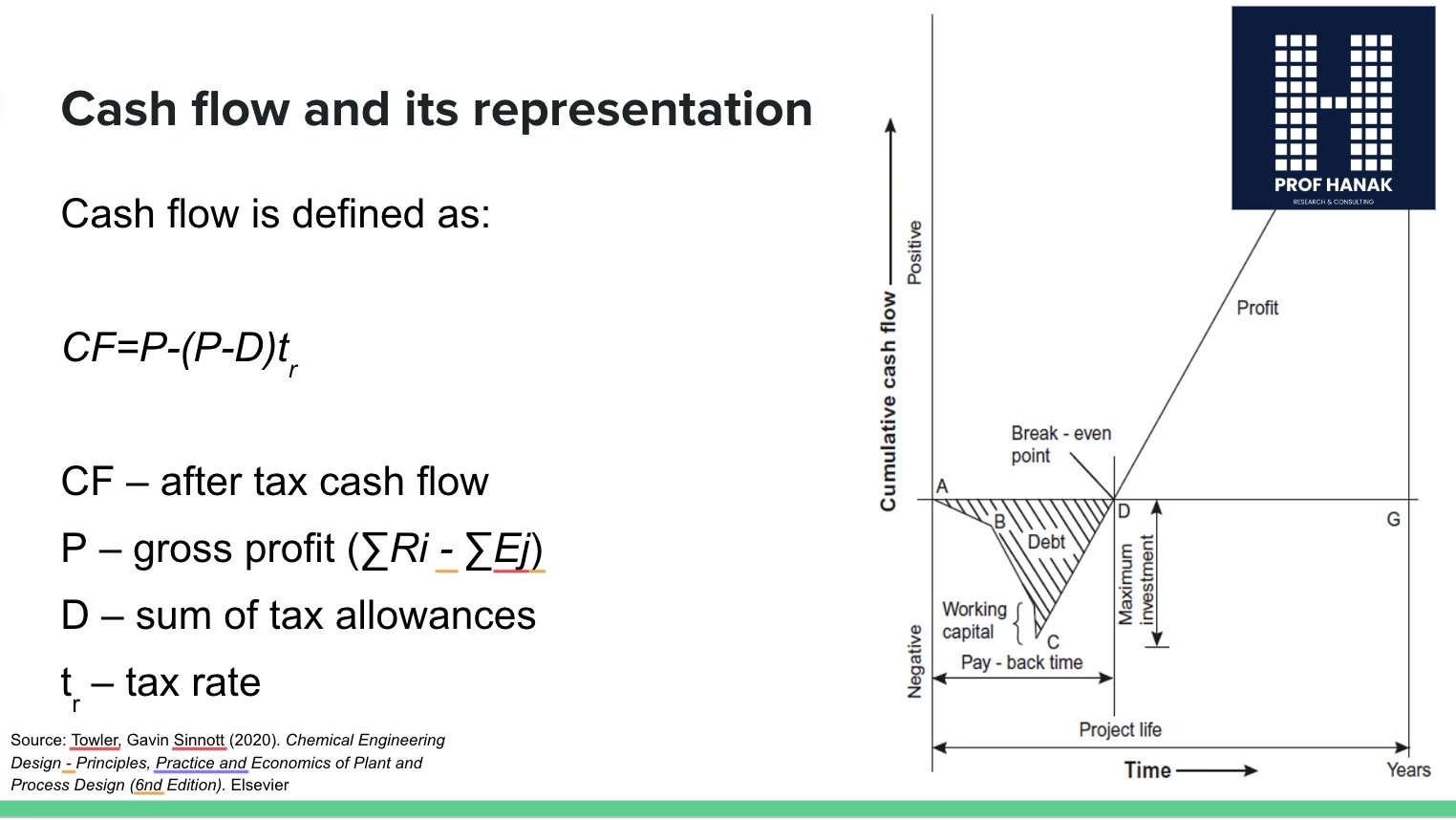
An investor looks at a project through its cash flows: NPV, IRR, ROI and payback.
That is why my team moved from the LCOE method to a net present value approach in the 2019 study. With the capital cost held the same, the break-even electricity price came out 6.8 €/MWh above the LCOE.
With the as-spent capital cost as well, it was 18.9 €/MWh higher than the LCOE from 2017, an increase of 29.3% for the same plant.
A significant change in the final figure, due only to the method.
The fix is to lead with the metric the decision makers use.
Build your TEAs on cash flows over construction and operation, with tax, depreciation and the financing structure stated. You may still keep the levelised cost alongside it, because reviewers from your own field will look for it, but make the number that represents the investment your headline.
When your headline number is the one the investor would compute, they can set it beside every other deal on their desk, without rebuilding it first. We build the economic metrics in the cohort on your own cash flows, with the downside case behind your cost range.
None of this will make an early TEA accurate. It will still be wrong, and a good reviewer knows that. What changes is that they can see how you got there, and trust the method to get closer as your data arrive. So before your next review, ask yourself: could the person reading this rebuild your capex, your design basis and your headline number from what is on the page? If the answer is no, the cohort is where you build the model yourself.

Join the TEA cohort waiting list. The first small-group cohort is planned for early 2027. Dates and fee are not fixed yet. People on the waiting list hear first and get first refusal on places: drhanak.com/training-sign-up
How I help you
I help GreenTech companies, including carbon removal and carbon capture companies, determine whether their technology and business case are ready for the next funding, offtake, diligence or deployment decision.
I independently challenge the engineering, economic and environmental assumptions behind the business case.
The aim is to understand what the evidence supports, which assumptions matter most, where the main evidence gaps are, and what needs to be resolved before the next decision.
I do this in 3 ways:
- Train: I teach founders and their technical teams to build and defend their own TEA, through a small-group cohort planned for early 2027 and training for teams. Join the cohort waiting list at drhanak.com/training-sign-up.
- Review: Through the Commercialisation Readiness Review, I independently review your technology, TEA, LCA, assumptions and risks, so you know what the evidence supports before the next commercial decision.
- Design: Through the Scale-Up & Techno-Economic Assessment and the LCA & Carbon Integrity Assessment, I design the TEA and LCA around your technology, your scale and the decision in front of you, covering CAPEX, OPEX, scale-up, lifecycle emissions and uncertainty.
Teaching and reviewing stay apart. If I have trained your team or helped build your model, I will not present a later review of it as independent without saying so.
You receive validated, evidence-based numbers; an assessment of the main data and evidence gaps; and a practical view of what needs to happen next.
No black-box models. No optimistic assumptions left unchallenged. No TEA and LCA sitting in isolation from the engineering.
Send me a message if you need to know what your evidence really supports before you commit capital, publish claims, or sign contracts.
Who is Dawid?
Professor Dawid Hanak is a global expert in techno-economic assessment, life-cycle assessment and the commercialisation of GreenTech, carbon removal and carbon capture technologies. A 15+ year practitioner, he has led more than 50 research and commercial projects, secured over £5 million in external funding, and advises the UK Government on carbon management technologies.
If you enjoyed this content, please follow, reshare, and subscribe to see more.